Clairify AI
Designing an AI Chief of Staff for Executives
A single AI-generated stream of actionable stories that helps executives cut through fragmented communication and focus on what matters.
Context - Problem
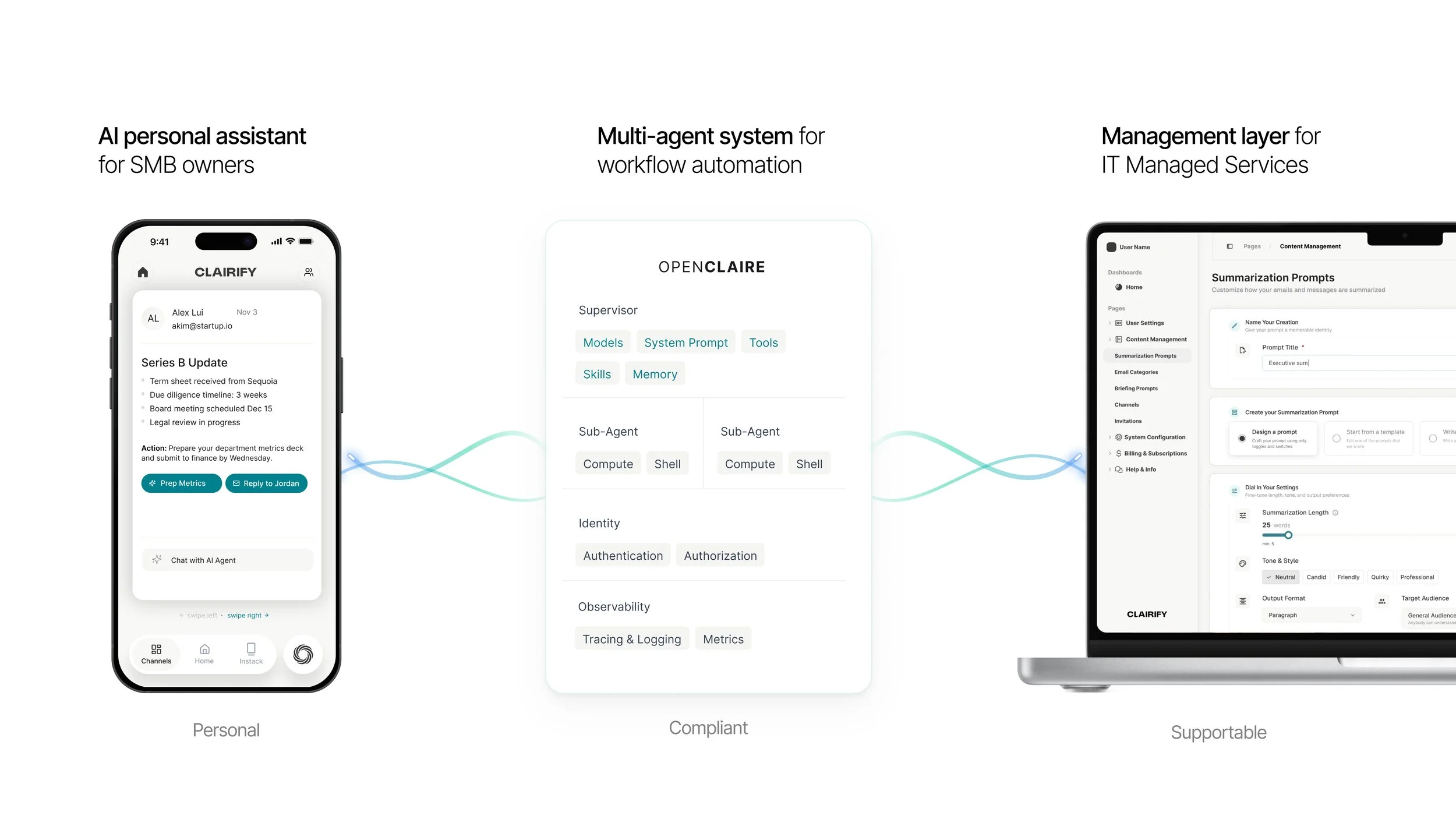
75% of U.S. small businesses rely on Managed Service Providers (MSPs) to manage their IT infrastructure. But as AI adoption accelerated, MSPs had no clear way to deploy, manage, or support AI assistants for their clients.
At the same time, executives were drowning in fragmented communication across Slack, Gmail, Outlook, and calendars which was creating constant context switching, missed priorities, and cognitive overload.
Existing tools did not solve both sides of the problem. ChatGPT was built for individuals, while open-source AI tools required technical setup and ongoing maintenance. Neither supported the multi-tenant, compliant, MSP-managed model needed for business deployment.

Tools
Solution
Clairify was the opportunity to close this gap.
An AI Chief of Staff that turns scattered communication into actionable stories, helping executives focus on what matters while giving MSPs a scalable way to deliver AI assistance.
Role
I led product design from concept to launch, partnering with the product manager and engineers on product vision, AI workflows, system architecture, interaction design, and design systems across mobile and web.
My Role included:
Defining the core AI communication experience
Creating the Stories interaction model
Leading usability testing and iteration
Building a 200+ component design system in under two weeks
Shaping the end-to-end iOS and web experience
My Impact:
Contributed to Clairify’s $2M valuation
Shipped the flagship iOS and web platforms
Established product foundations for MSP-enabled AI deployment
The Challenge
This was a systems design challenge with two distinct stakeholder groups.
Executives Need
Speed
Clarity
Reduced cognitive load
Faster decision-making
MSPs Need
Multi-tenant support
Compliance readiness
Scalability
Centralized management
The challenge was creating an experience that felt like a simple AI assistant while supporting complex backend infrastructure and distribution requirements.
Research → Insight → Pivot
When I joined Clairify, the product was designed as a traditional inbox-style experience: a familiar list-based system with basic email interactions. For me to understand how well this approach was meeting our users needs, I conducted early usability testing on the existing concept.
But early usability testing showed it was not improving executive efficiency. Users were still manually triaging information, switching between tools, and deciding what deserved attention.
We began hearing consistent feedback:
“I wish I could only see each email once at a time.” - Caleb, Clairify User
“I have so many emails that I end up just reading subject lines instead of processing them.” - Jonathen, Clairify User
To validate this pattern, I interviewed 8 MSP executives through outreach and existing IT relationships.
Across the interviews, a clear pattern emerged: Users did not want more email functionality.
They wanted a single pane of glass that reduced decision-making effort.
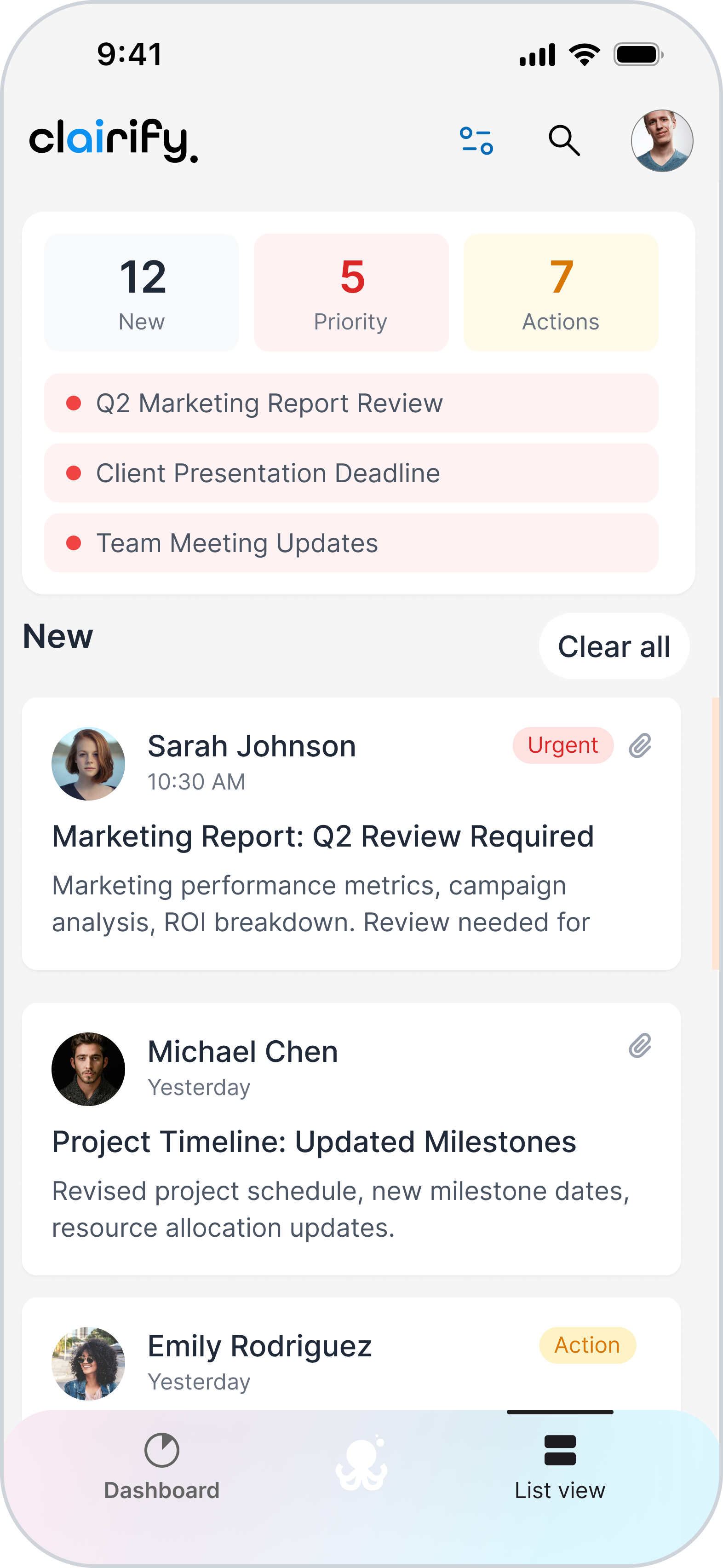
Starting Point: Existing Inbox Concept
Key Insight
The problem was not information access.
It was information overload and lack of structured attention.
Users were not failing to receive information. They were struggling to process it efficiently.
Pivot → Solution: Stories
The research shifted Clairify from inbox management → focused decision-making.
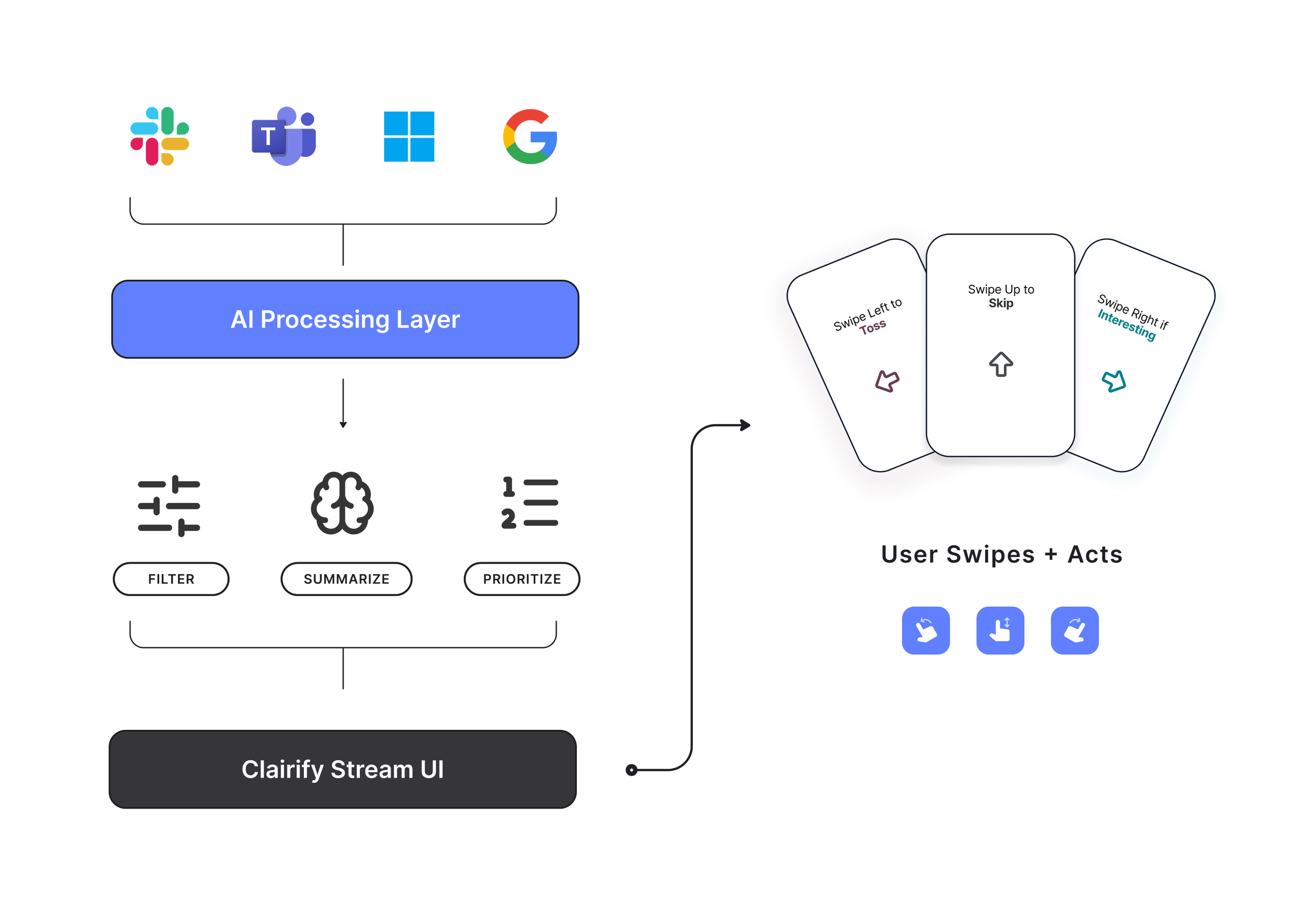
Instead of optimizing lists, filters, and sorting, we redesigned the experience around one decision at a time. Clairify uses AI as an attention filter, transforming fragmented emails, messages, and updates into prioritized, actionable stories based on context and urgency.
After exploring multiple models, we landed on a gesture-based system for rapid triage while preserving user control.
The goal was not to create another inbox. It was to design an AI assistant that understands what deserves attention.
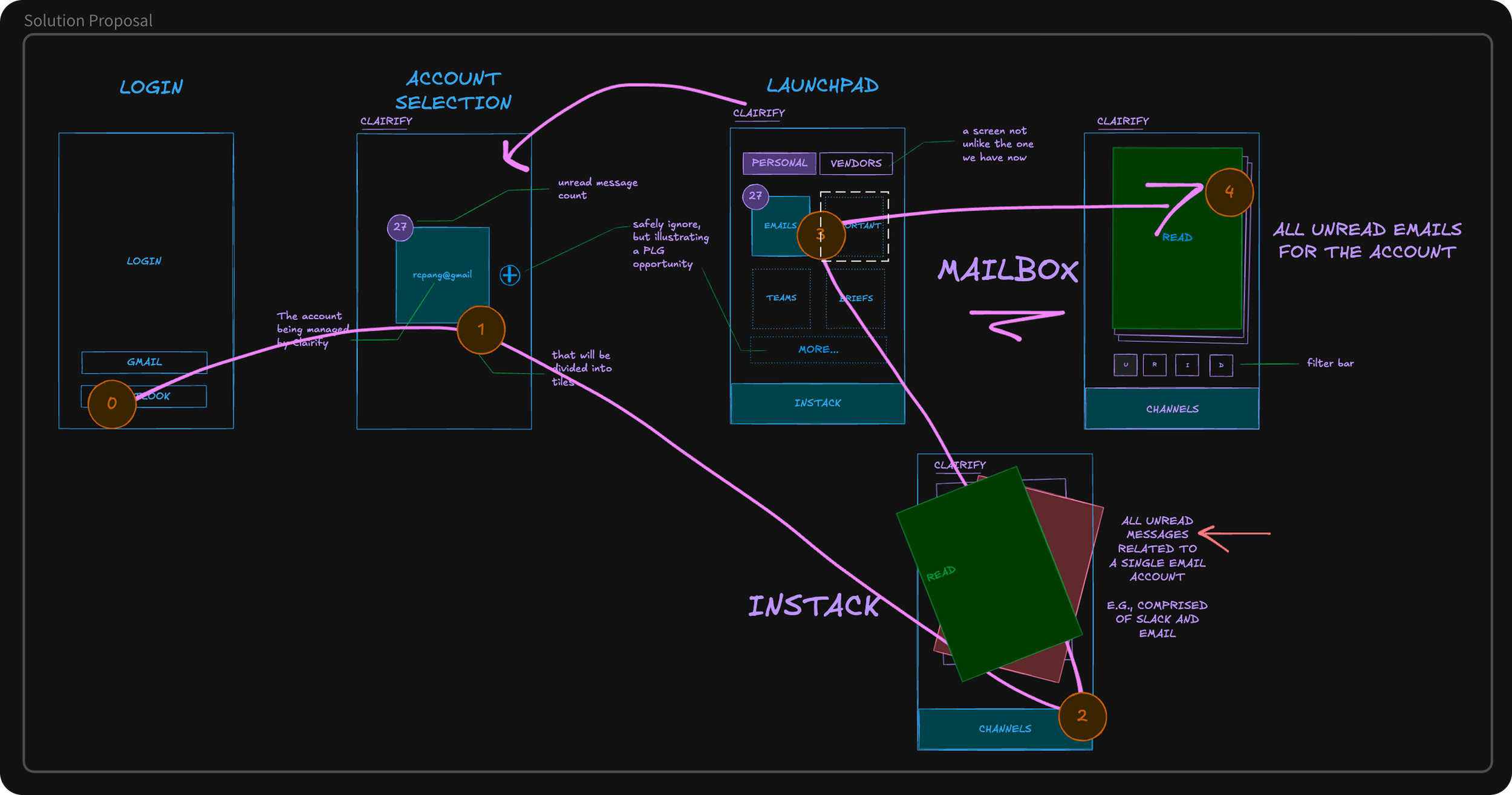
Phase 1: Exploration for User Experience Pivot
Phase 2: Defining the core AI communication experience and stories interaction model
Phase 3: Design the new model
Interaction Design
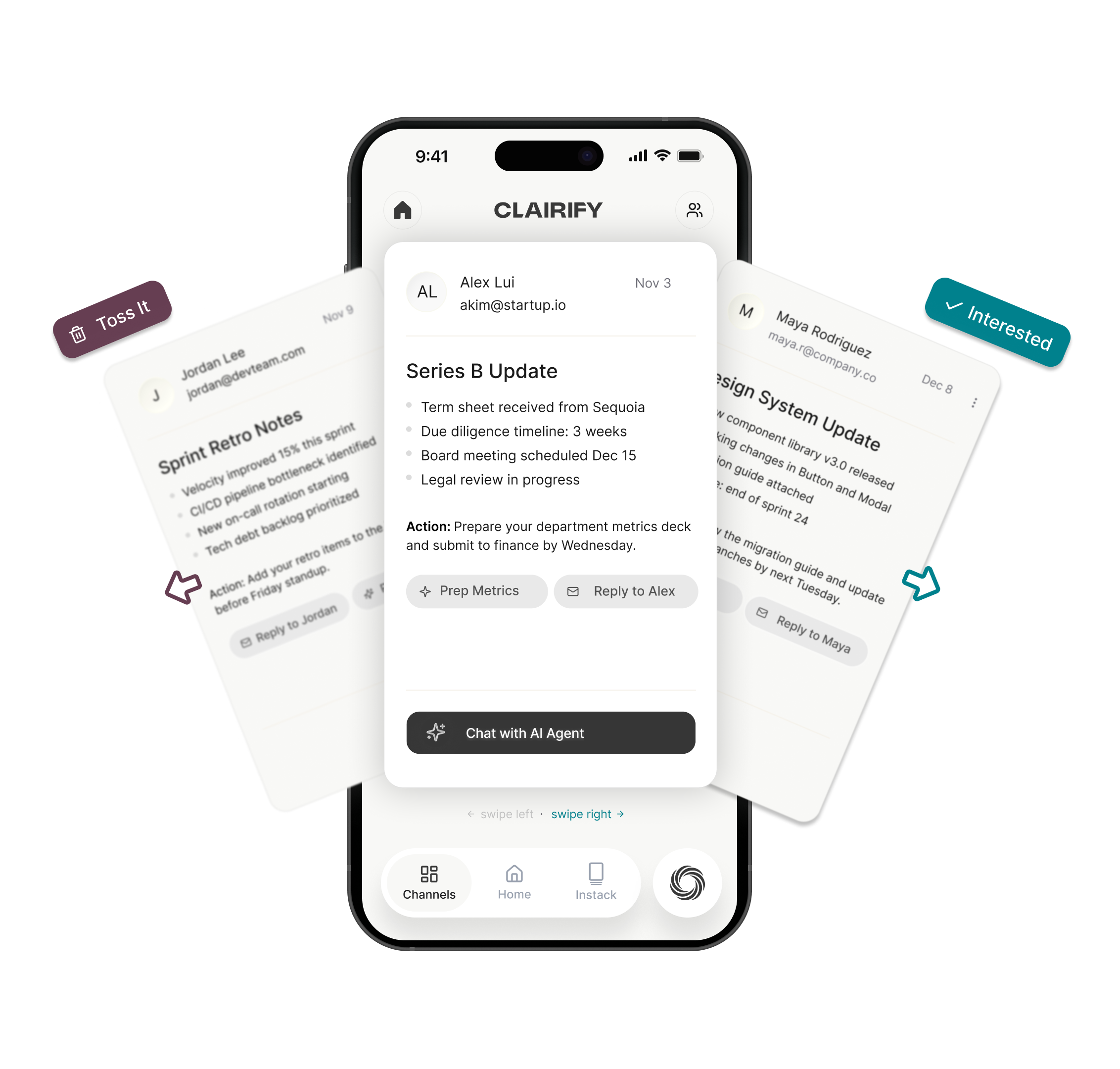
Instead of presenting communication as a dense inbox, Clairify presents it as a fast, consumable stream of “stories.”
Each story becomes a single decision moment.
Swipe Left to Toss
Swipe Right if Interesting
Swipe Up to Skip or View Later
Validation
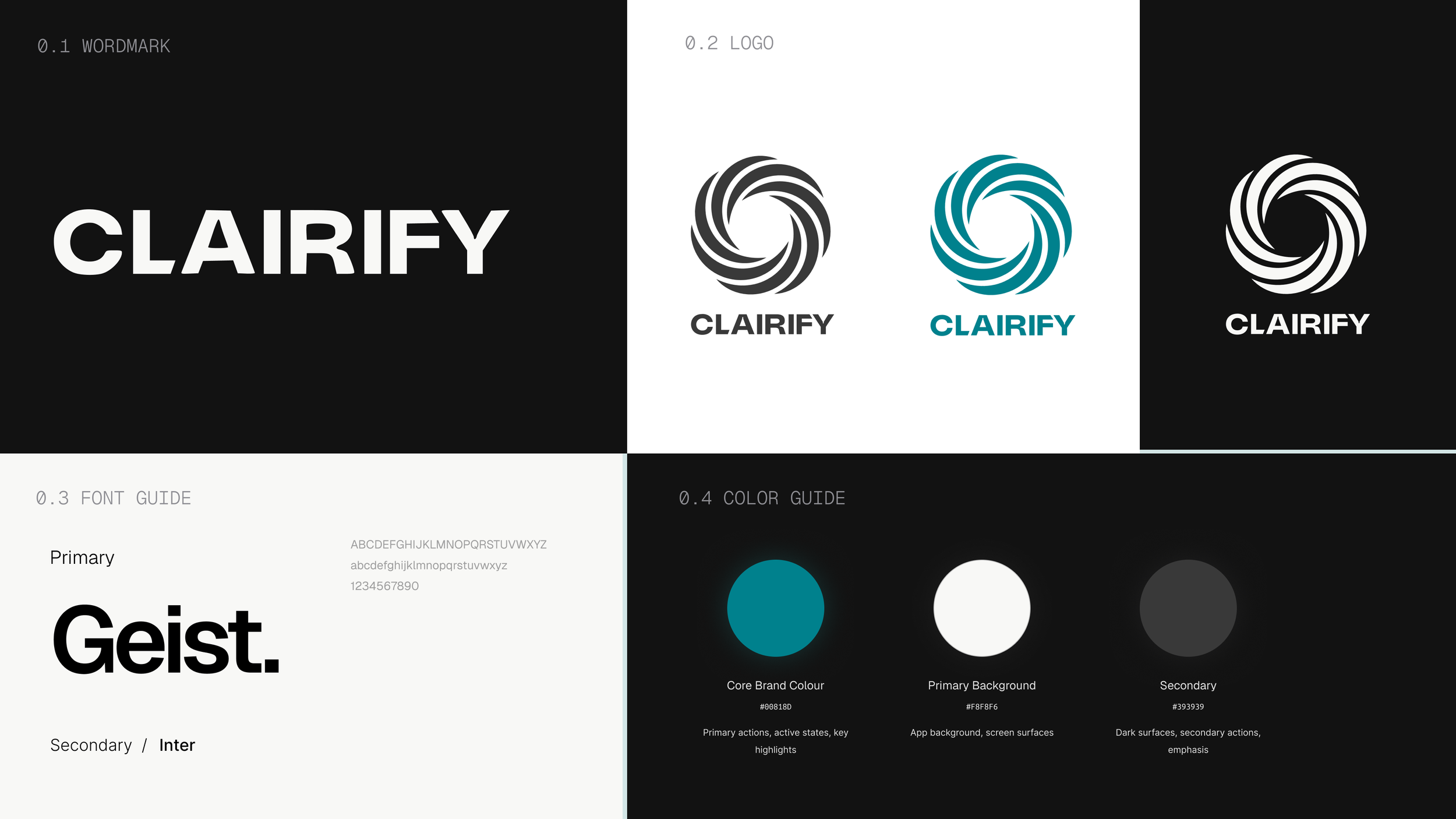
Art Direction
We tested the redesigned Stories experience with the same 8 MSP executives.
Results
~75% reported improved efficiency
Users consistently reached inbox zero
None had achieved inbox zero with their previous workflows
Inbox zero was not a vanity metric — for executives, it represented control over constant communication flow.
Design System
To move quickly at an early stage, I built a 200+ component design system in under 2 weeks, creating consistent interaction patterns across the product.
This enabled:
Faster feature development
Consistent AI interaction patterns
Scalable and maintainable UI
Outcomes & Learnings
Contributed to early-stage growth and $2M valuation
Reduced communication friction through structured workflows
Established a scalable foundation for future product development
The biggest learning was understanding what it means to design in an early-stage startup environment: moving quickly, building from 0 to 1, and making design decisions that support both user needs and business goals.
I also learned that collaborating early with engineers and product teams can completely shape the outcome of a product, and also can help ideas move faster and more intentionally instead of designing in isolation and having to backtrack later. It showed me how cross-functional collaboration can accelerate a product in a much stronger direction.